
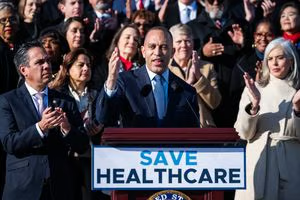
For five years, millions of Americans experienced a version of the healthcare marketplace where insurance felt truly accessible. Thanks to enhanced premium tax credits introduced during the pandemic, many families saw their monthly payments drop to as little as ten dollars. These subsidies expanded eligibility to middle-income households that previously earned too much to qualify for help, capping their premiums at 8.5 percent of their annual income. It was a transformative era for the Affordable Care Act, pushing enrollment to a record 24.2 million people and providing a lifeline for those who had long avoided doctors due to prohibitive costs.
That stability evaporated on January 1 when the credits officially expired. While the original program was meant to be temporary, it became a cornerstone of millions of family budgets through successive extensions. However, making these subsidies permanent proved politically impossible. The Congressional Budget Office estimated that permanent relief would add roughly 335 billion dollars to the national deficit over a decade, a price tag neither party could stomach. Republicans argued the credits artificially inflated an inefficient system, while Democrats warned that letting them lapse would leave millions uninsured.
The final collapse happened not through a dramatic repeal or a court ruling, but through simple legislative inertia and political gridlock. As insurers began pricing plans for 2026, they did so under the assumption that help was vanishing because Congress provided no sign of renewal. A chaotic autumn featuring a government shutdown further paralyzed action. Even when a small group of House Republicans attempted to force a floor vote in December, they were too late to stop the clock from running out on December 31.
Now, the consequences are manifesting in real time as hundreds of thousands of people drop their coverage throughout open enrollment. According to current projections, nearly four million more people per year will remain uninsured through 2034, facing steep premium hikes and losing access to affordable prescriptions and routine checkups. After fifteen years of failed attempts by some lawmakers to dismantle the ACA via legislation or litigation, the most significant blow ended up being nothing more than silence from Capitol Hill.